
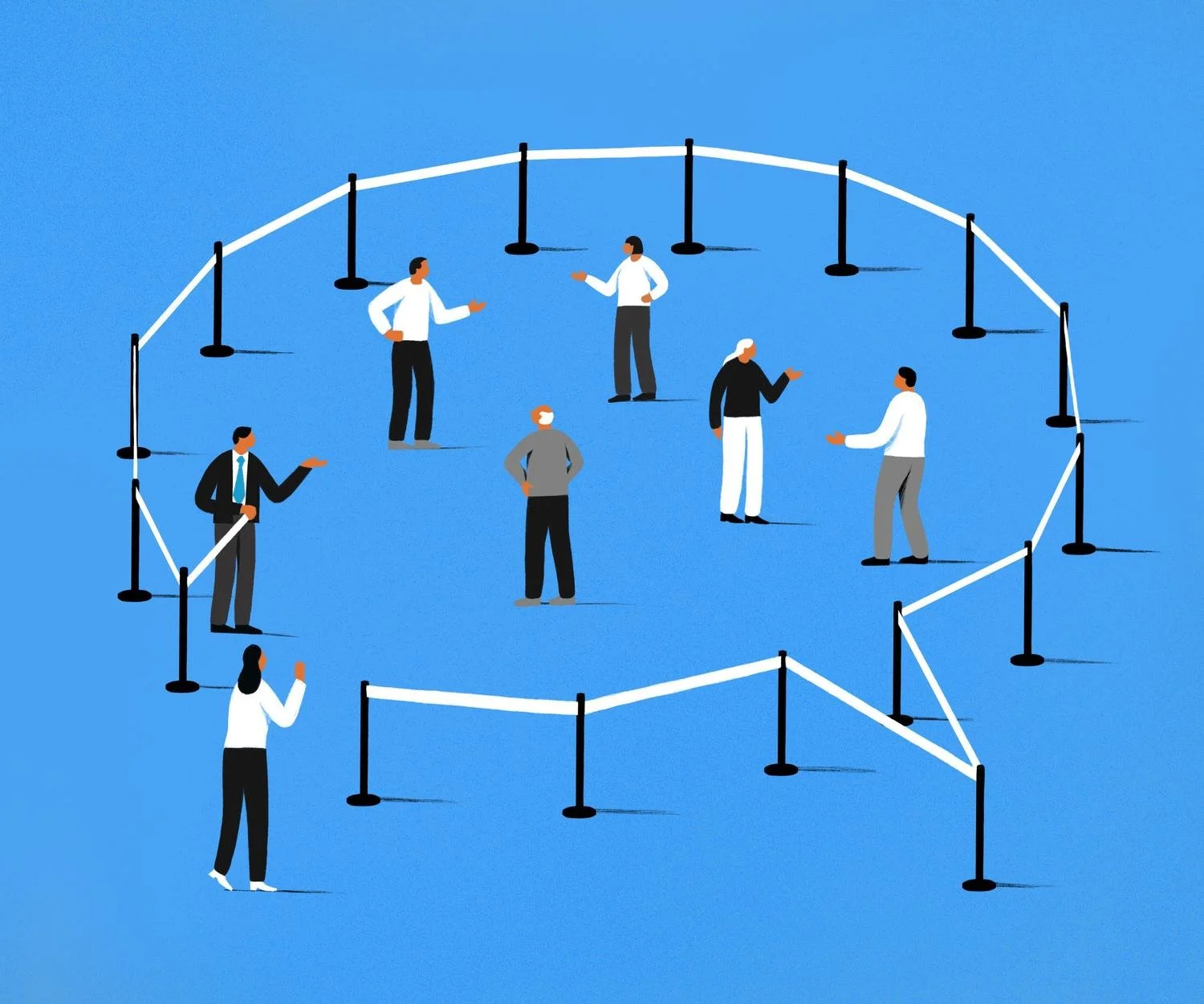
What Stops Working When Your Team Doubles
Early teams do not succeed because of their processes. They succeed because of proximity.
When a company is small, people share context automatically. They overhear conversations, work in adjacent spaces, and develop an informal understanding of what everyone else is working on and why. Trust builds through repeated interaction. Misalignment corrects quickly because people have enough shared context to notice it.
None of this is designed. It is a byproduct of smallness.

The Organizational Cost of AI Strategy
Most AI strategy is being treated as an efficiency play. In practice, it reduces the relational capacity organizations depend on to function, and that creates instability.

Why Alignment Doesn’t Survive Execution
Most organizations believe they are aligned because a decision was made and communicated. There was a meeting, direction was set, and people left with a shared sense of what should happen next. For a short period, that holds.
Then the same topic comes back.

Why Your Organization Feels Slower Than It Should
Most organizations do not experience slowness as a single problem. Work is getting done, people are moving, and decisions are being made. From the outside, there is progress. Inside, things take longer than expected. Conversations repeat, decisions require multiple passes, and work that should move cleanly starts to drag. Teams revisit the same issues across meetings, alignment has to be re-established more often than it should, and momentum is harder to sustain.

Psychological Safety Is Built or It Doesn’t Exist
When psychological safety is not built, the effects do not stay contained to individual interactions. They accumulate into the structure of the organization.
Small omissions compound. Information is held back, concerns go unvoiced, and decisions move forward without full visibility. Over time, this creates gaps that are not immediately visible but shape how the organization operates.

Why Your Co-Founder Fight About Strategy Isn’t Actually About Strategy
Most co-founder conflicts are framed as misalignment. Two people see the business differently. They have different instincts about risk, timing, or strategy. The solution is assumed to be better decision-making—clearer roles, more data, or a stronger framework for resolving disagreement.

Your Feedback Isn’t Landing Because You Haven’t Earned the Right to Give It
Feedback does not operate as a standalone skill. It operates within the limits of a relationship.
Every working relationship has a certain capacity—an ability to hold tension, disagreement, and correction without destabilizing. When that capacity is high, feedback can be imperfect and still land. When it is low, even precise and thoughtful feedback produces defensiveness or distance.

I Promoted My Best Engineer and Lost Both an Engineer and a Manager
When someone moves from individual contributor to manager, the work changes. That part is well understood. What is less visible is that every relationship around that person changes at the same time.
They are no longer a peer to the people they worked alongside. They now carry authority, whether they are comfortable with it or not. Their words have different weight. Their decisions have different consequences.

The Relational Health Diagnostic for Scaling Startups
In a small team, relationships form naturally through proximity. People share context, correct misalignment quickly, and build trust through repeated interaction.
As the company grows, that dynamic changes.
The number of relationships increases faster than any one person can maintain. Context becomes unevenly distributed. People rely more on roles and processes to coordinate work. The informal connections that once held the system together start to thin.

What Your Company Actually Lost in the Layoff (It Wasn’t Just Headcount)
A layoff does not only remove people from an organization. It changes the meaning of being in the organization.
Before the layoff, employees operate with an implicit understanding of their relationship to the company. That understanding shapes how they commit to the work, how they take risks, and how they interpret leadership decisions. It is rarely stated directly, but it is reinforced through experience.
When a layoff happens, that understanding shifts.